
They Tried AI. It Failed Them. Why Authors Are Returning to Human Ghostwriters

How the "AI refugee" phenomenon is reshaping demand for professional ghostwriters and what it means for your authority as an author.
They Tried AI. It Failed Them
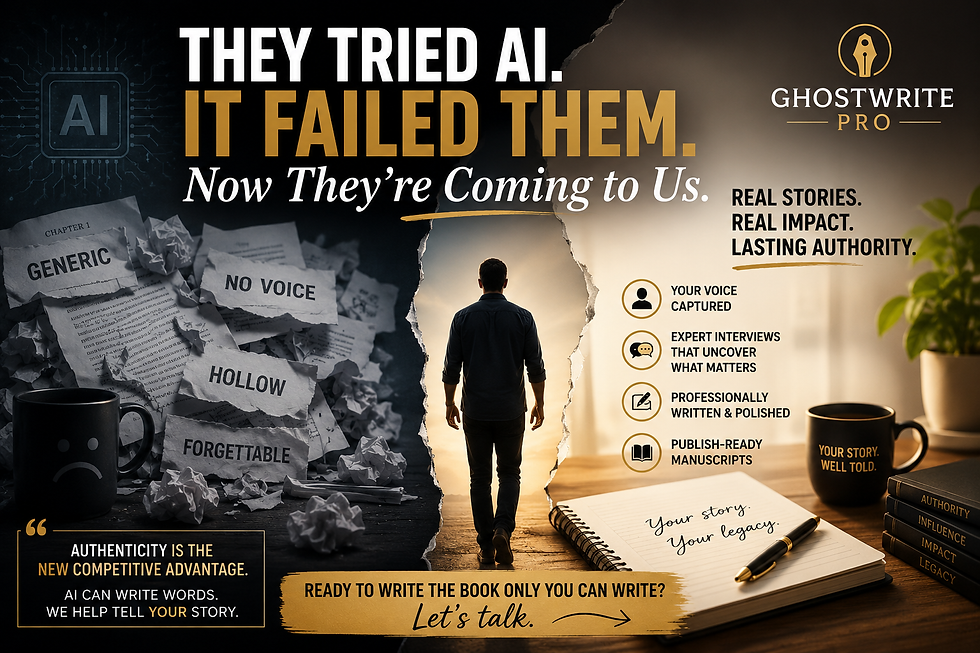
Something unexpected is happening in the publishing world right now. At the very moment everyone predicted AI would make ghostwriters obsolete, the phones are ringing louder than ever.
In agencies across the country, a new kind of client is arriving—embarrassed, frustrated, and relieved to have found a real human at last. The industry is calling them AI refugees: executives, entrepreneurs, and aspiring authors who spent weeks or months trying to write their book with ChatGPT, only to end up with something hollow, generic, and entirely forgettable.
The Flood of "AI Slop" Created a Premium on Authenticity
When generative AI made it possible for anyone to produce a 60,000-word manuscript in an afternoon, the internet didn't get better — it got noisier. Readers quickly developed a sixth sense for machine-written prose. Publishers, too. The result? A marketplace that is actively hungry for writing that sounds like a real person lived it, thought it, and cared enough to say it well.
Dan Gerstein, CEO of Gotham Ghostwriters, summed it up bluntly: the exponential growth of AI-slop is creating powerful market pressure on authors to tell original, differentiating stories. The bots simply cannot approximate what an accomplished human writer delivers.
Why AI-Written Books Feel Hollow
Here's what these clients have in common: They had great ideas. They just couldn't make AI understand the texture of their experience—the specific boardroom moment, the hard-won lesson, the failure that changed everything. AI gave them outlines. Ghostwriters give them meaning. They tried AI. It failed them.
The core value of a human ghostwriter has always been the interview—the art of asking exactly the right question and then knowing what to do with the answer. That skill is not replicable by any model on the market today.
What Human Ghostwriters Actually Do
The pre-publishing process is evolving, too. Ghostwriters are increasingly acting as project architects—bringing manuscripts directly to publishers, smoothing the acquisition process, and helping clients skip years of querying. Publishers trust known ghostwriters. That trust shortens timelines and improves outcomes for everyone involved.
The Bottom Line for Aspiring Authors on AI Ghostwriting
If you've ever tried to use AI to write your book and found it missing something, that something is you. Your voice, your specificity, your irreplaceable perspective. That's exactly what a skilled ghostwriter is trained to find and put on the page.
The market is rewarding authenticity at a premium right now. There has never been a better time to invest in telling your story the right way.
Ready to write the book that only you can write? Let's talk.
FAQ Section
Can AI replace ghostwriters?
No. AI can generate text, but it cannot replicate lived experience, emotional nuance, or authentic storytelling.
Why are authors hiring ghostwriters after trying AI?
Many authors find AI-generated writing generic, repetitive, and lacking originality.
Is human ghostwriting still worth it in 2026?
More than ever. Authenticity has become a premium in publishing and branding.

Comments